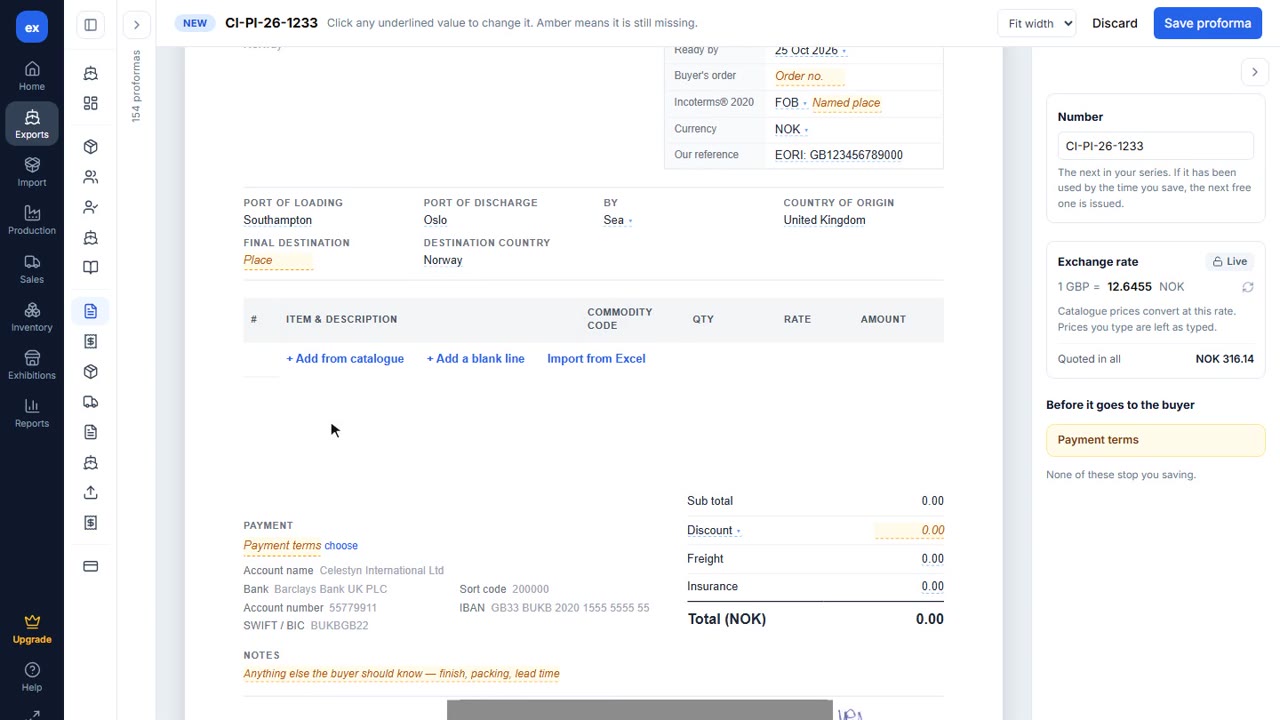
GOV.UK says the completed invoice and any licences or certificates must travel with goods leaving the UK. ExDocs Exports lets you enter a shipment once and produces the proforma, commercial invoice, packing list and certificate of origin from that entry. It does not make customs declarations, and you remain responsible for the accuracy of what you declare, including commodity codes, origin, values and licences.
What must travel with goods exported from the UK?
According to GOV.UK, the completed invoice and any licences or certificates must travel with the goods.
GOV.UK also says you need an EORI number that starts with GB to export goods from England, Wales or Scotland. See the EORI number guide.
You may need proof of origin if you are exporting to a country where your goods have a reduced or zero rate of duty.
If you have appointed someone to deal with UK customs for you, GOV.UK says they will make the declaration and get your goods through the UK border. At the other end, the person or business receiving the goods may need to make an import declaration in their country.
What value goes on an export invoice?
- If you are selling the goods, use the price you are selling them for.
- If you are not selling the goods, use the market value of the goods.
- List any freight or export insurance you included in the price separately.
What HMRC says about commodity codes for exports
HMRC describes commodity codes as internationally recognised reference numbers. A code describes a specific product when importing or exporting goods.
- You must find the right commodity code to classify the goods you are exporting.
- The code is used on any import declaration, and codes can be found in the Trade Tariff tool.
- Although many countries have signed up to the same classification system, only the first 6 digits are used worldwide, and product-specific decisions are particular to each country.
- If you rely on the commodity code from an overseas supplier, you will need to check whether the treatment is the same and how much of the code applies in the UK.
- The Trade Tariff tool can help you check whether you need a licence to move your goods.
How ExDocs builds export documents from one shipment record
In ExDocs Exports, you enter a shipment once and the proforma, commercial invoice, packing list and certificate of origin are produced from that entry. The module handles multiple currencies and calculates CBM on a click.
Across ExDocs UK, twenty-plus documents can be produced from one shipment record, built to UK rules.
- UK data is held in London.
- Every country runs on its own database, in its own region, with no shared global store.
- Every plan includes unlimited users, items and documents.
What ExDocs does not do
ExDocs helps you prepare trade documents. It does not make customs declarations for you, and it is not legal, tax or customs advice.
You remain responsible for the accuracy of what you declare, including commodity codes, origin, values and licences. ExDocs puts the details you enter onto the documents; it does not decide them for you.
The free packing list tool totals the volume you enter. It does not tell you what fits in a 40ft high-cube (40HC) container.
If you need a declaration made, a classification decision, or a plan for loading a container, a customs broker or freight forwarder is the better fit. For a single, unusual shipment, preparing the paperwork by hand with their help may also suit you better than setting up software.
Which export records do you need to keep?
GOV.UK says you must keep commercial invoices and any customs paperwork. If you are VAT registered, record the goods in your VAT accounts even if they are zero-rated.
When to get specialist help
You may need other documentation to get your goods into the destination country. GOV.UK advises asking the person or business buying your goods what information you need to provide.
- Choosing or checking a commodity code: a customs broker, or HMRC.
- Making the export declaration: a customs broker or freight forwarder.
- Origin, preferential duty rates or licences for a particular destination: a customs broker, or the relevant authority.
- Recording exports in your VAT accounts: your accountant.
- Working out how goods load into a container: your freight forwarder.
Related reading
Sources
- GOV.UK: Export goods from the UK: step by step
- HMRC: Finding commodity codes for imports into or exports out of the UK
Checked against the official sources above on 18 November 2026. Rules and forms change, so confirm the current version on the official page before you act.